← Back to work
03 | Research · Consumer Finance

Reimagining Digital Checking for Military Members and Veterans

Company Financial Services Company
Team Lead Researcher, Experience Designer (me), Principal, Consultant, Associate
Checking Members 5–7M
Market Cap $5–10 billion
Checking Account Redesign

Transforming digital checking experience for Military, Veterans and their families

A Fortune 500 financial services company founded in 1922, exclusively serving U.S. military members, veterans, and their families. It offers banking, insurance, investments, and retirement products to a highly loyal, mission-driven membership base.

Despite strong brand trust, the company faced mounting pressure to modernize its digital checking experience, competing against leading fintech disruptors that were winning younger military families with sleek, mobile-first banking.

The opportunity: redesign the checking product to better serve members navigating deployments, frequent relocations, and variable income cycles.

MY ROLE & TEAM

Design: Lead Researcher + Experience Designer

Business: Principal + Consultant + Associate

Modernize the Checking Account Experience

01
Position Checking as primary account
02
Revamp & Uplift UI/UX experience
03
Cross sell products from the Ecosystem

Key Friction Themes in the Existing Checking Experience

Through ethnographic interviews across Active Duty, Veteran, and Family/Associates user groups, we uncovered four key friction themes.

📚
Financial literacy gap

Fear and confusion about core concepts (saving, credit, budgeting) is universal. For military, this extends to decoding benefits like TSP and BAH. For veterans, it's the shock of losing subsidized structures after service.

🔧
Tools that feel generic or broken

Users don't trust products that weren't built for them. Military members flagged the bank's UX failures specifically. Associates experience decision fatigue from too many competing offers.

💳
Debt and savings pressure

Living paycheck-to-paycheck, managing credit card debt, and having no emergency buffer are persistent stressors across all segments, with distinct flavors for each group.

🔒
Trust and access friction

Whether it's fear of predatory practices (veterans), disrupted banking during relocation (military), or jargon-heavy fine print (associates), people are blocked from acting even when they want to. The bottleneck is confidence, not intention.

Three phases of human-centered design

PHASE 01 Deep User Research for Real Insights

I partnered with the lead researcher to transform ethnographic interview findings into actionable insights, ensuring stakeholder alignment before moving into ideation. I then owned and led the design of 50+ assets for an immersion workshop: from journey maps and insight posters to stimulus cards and concept frameworks, while also supporting logistical planning to ensure a seamless experience.

My Role
Insight translation + full ownership of workshop design assets

Partnered with the researcher to surface key insights that informed the design approach, then took complete ownership of all 50+ visual assets for the immersion workshop.
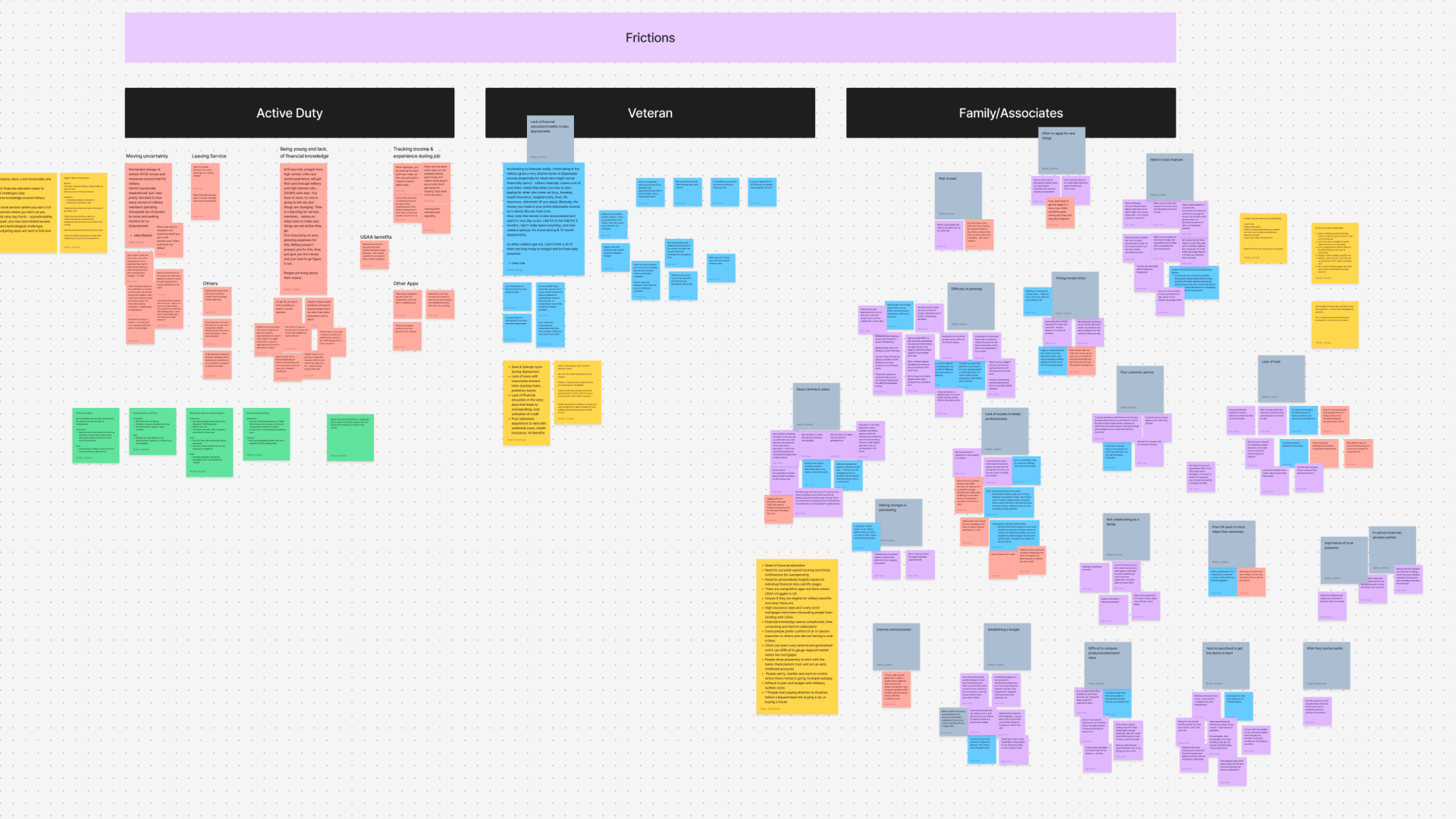
Phase 1: Deep User Research
PHASE 02 Co-Creation with Stakeholders

I facilitated sessions across a two-day in-person workshop with stakeholders, guiding them through user pain points, research findings, competitor analysis, industry trends, and best-in-class examples. From those sessions, I inspired the development of 10+ concept prototypes, refining them through real-time feedback and iteration. We then narrowed down to 4–5 strong directions through a structured voting process.

My Role
Facilitation + concept mockup creation

Led concept mockup creation for the next round of ethnographic testing. Synthesized key insights and designed refined concept mockups that translated stakeholder thinking into testable prototypes.
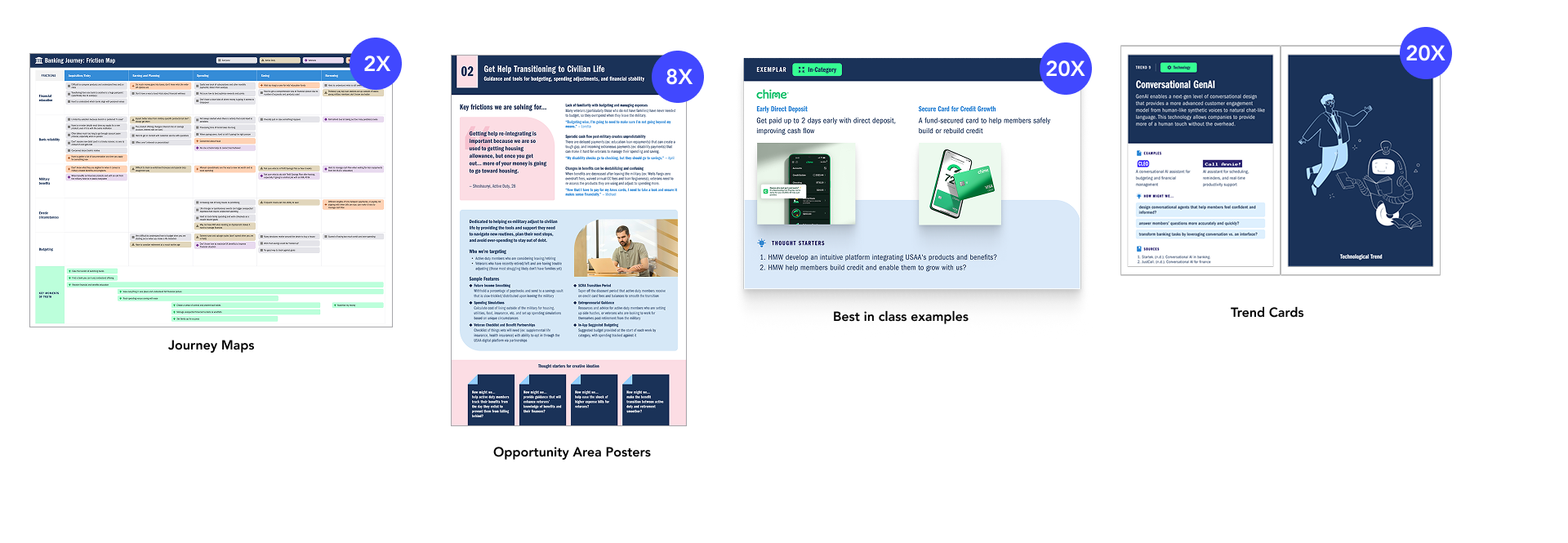
Phase 2: Co-Creation with Stakeholders
PHASE 03 Concept Validation and Refinement

With 4–5 high-impact concepts shortlisted, I created low-fidelity prototypes to test usability and concept desirability before investing in high-fidelity design. I then conducted iterative testing sessions with 6+ real users across Active Duty, Veteran, and Family/Associate segments, refining concepts based on behavioral insights and usability feedback until we had a clearly validated direction.

My Role
Prototype creation + iterative user testing

Led the design of all low-fidelity prototypes and conducted 6+ testing sessions across user segments, synthesizing findings into refined concepts ready for the next phase of investment.
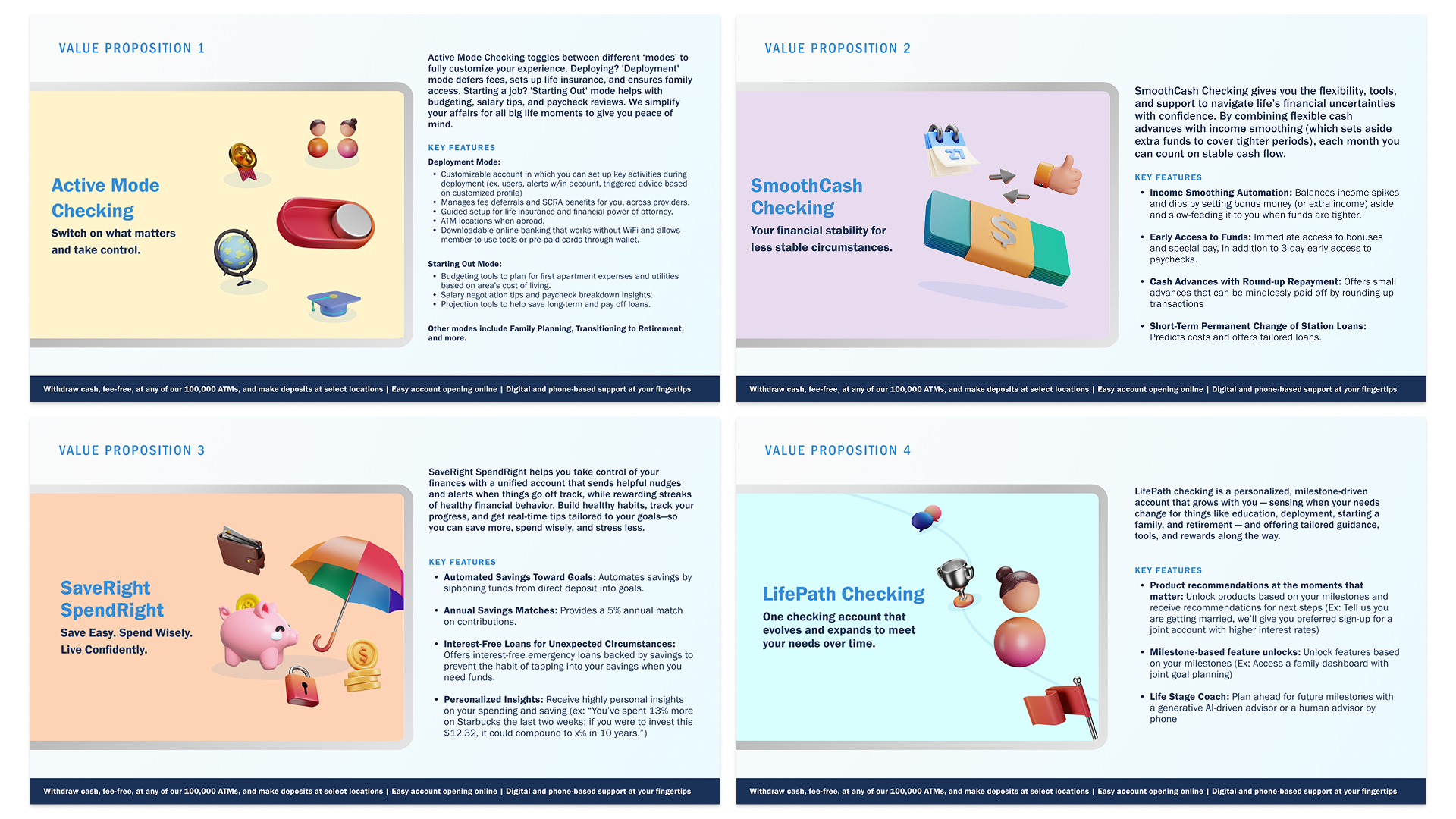
Phase 3: Concept Validation and Refinement

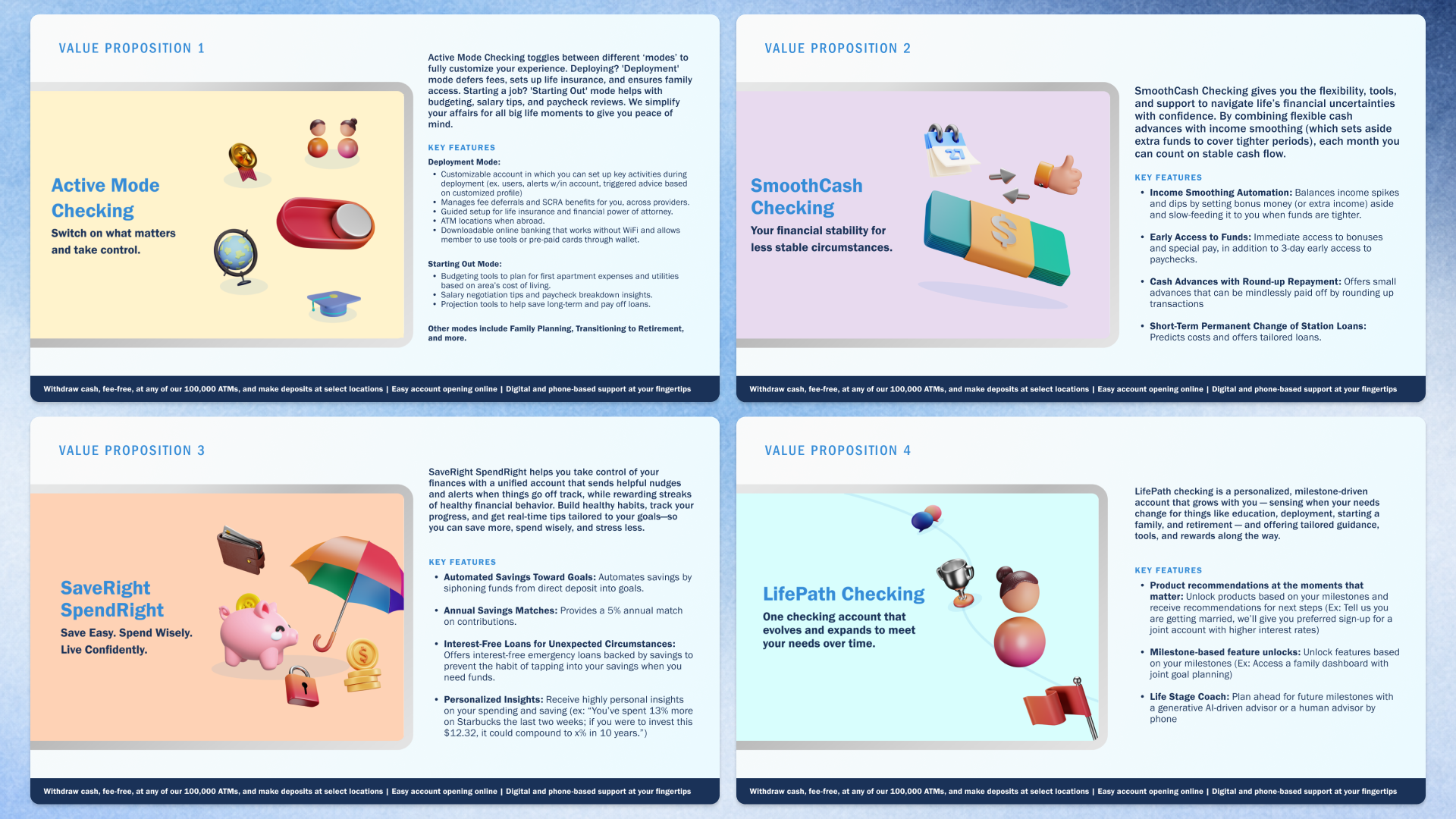
Four concepts validated with real military members and veterans.

Each concept was co-created with stakeholders, refined through field research, and tested with real users, giving us clear signal on desirability before any investment in high-fidelity design.

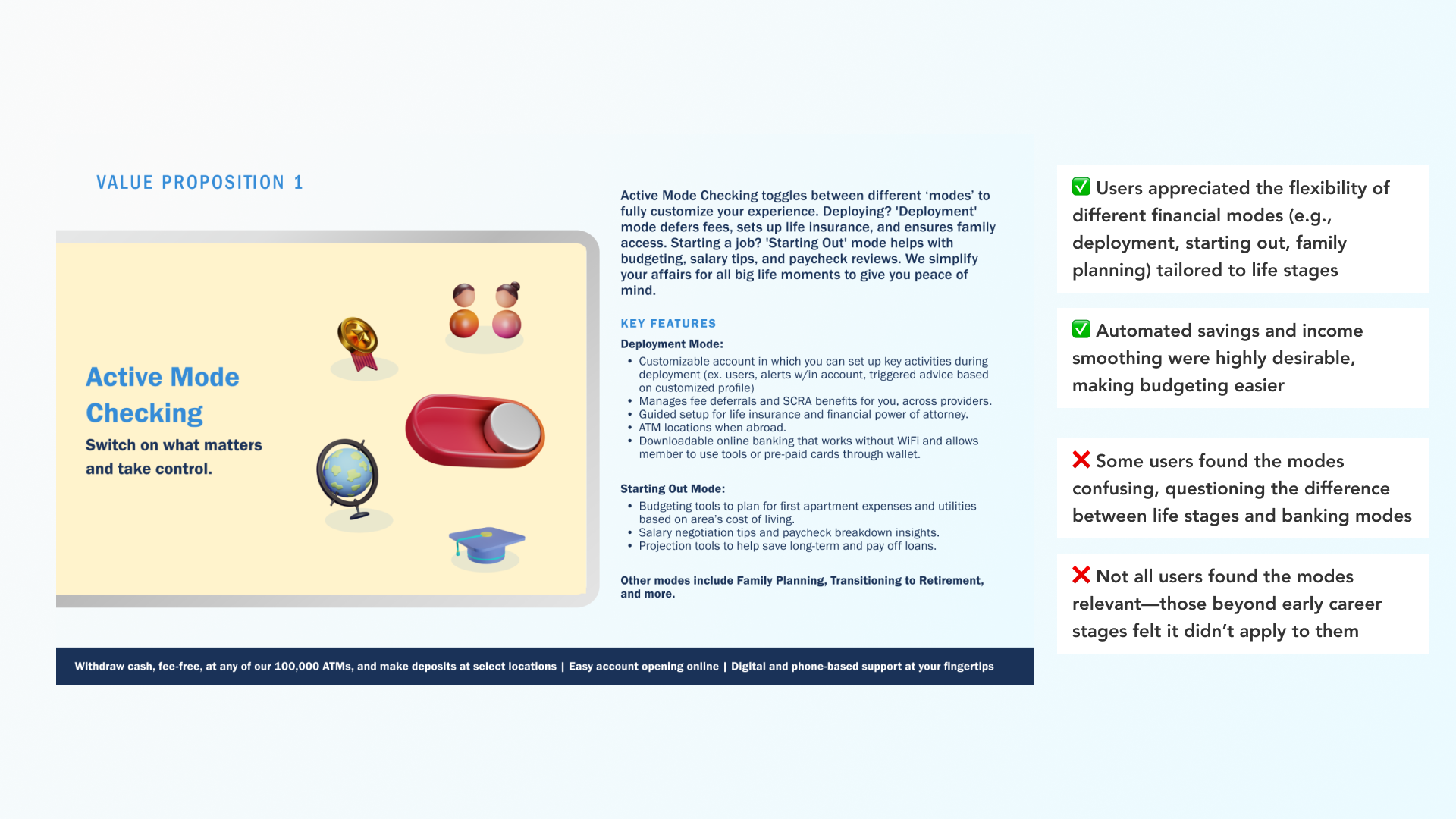
Active Mode Checking
Value Proposition 01 · Active Mode Checking
Switch on what matters and take control.
🔍 Problem

Military members face radically different financial needs depending on their life stage (deployment, transitioning out, starting a family) but their checking account treats everyone the same.

💡 Design Decision

Active Mode Checking toggles between life-stage 'modes' to fully customize the experience. Deploying? Mode defers fees, sets up life insurance, and ensures family access. Starting out? Mode guides budgeting and paycheck management. Other modes cover Family Planning and Transitioning to Retirement.

📊 User Testing

Users appreciated life-stage flexibility and loved automated savings. Some found the concept of "modes" confusing; the line between life stages and banking modes needed clearer framing.

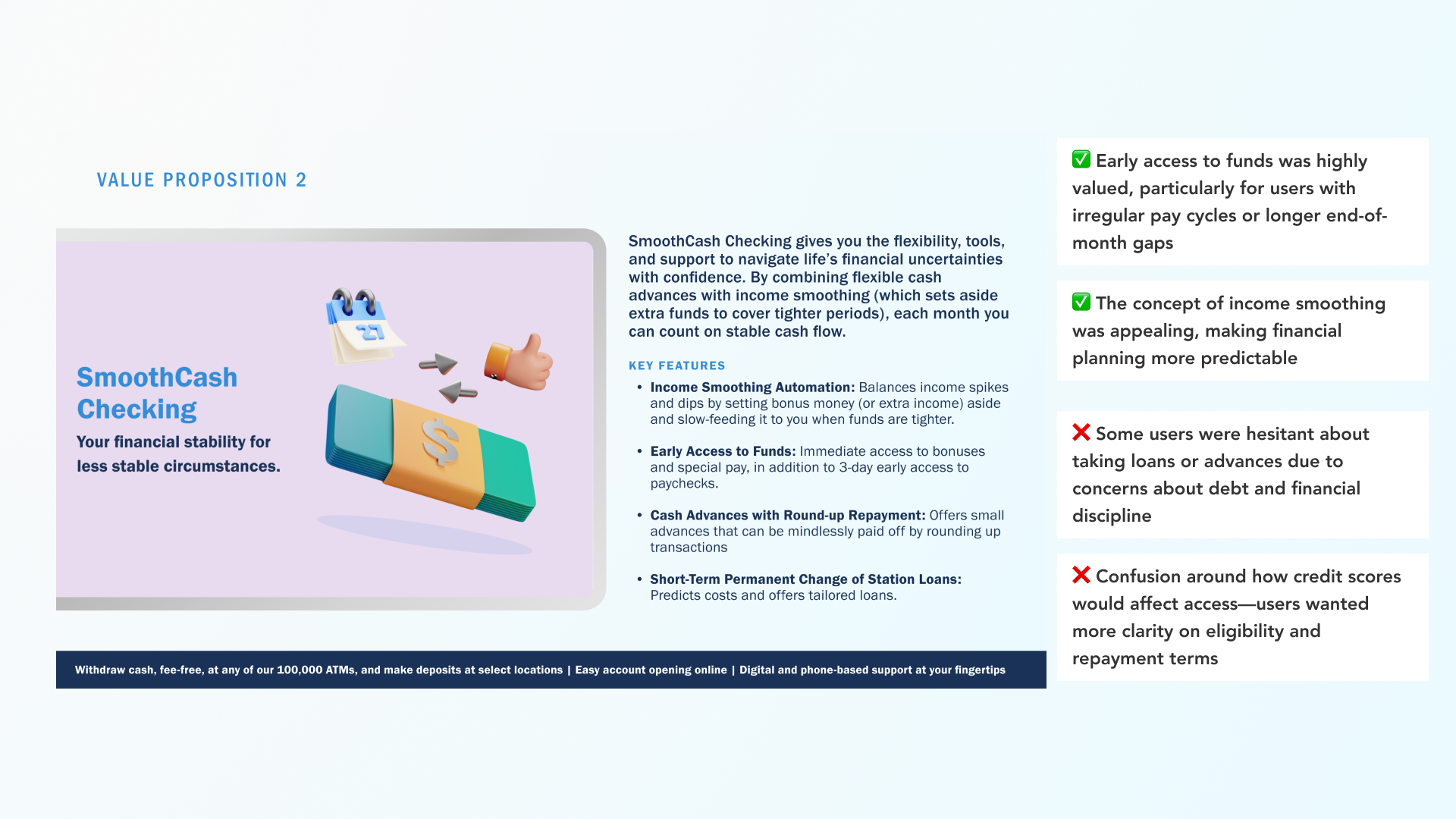
SmoothCash Checking
Value Proposition 02 · SmoothCash Checking
Your financial stability for less stable circumstances.
🔍 Problem

Military pay cycles are unpredictable: bonuses land late, PCS costs hit unexpectedly, and end-of-month gaps leave members scrambling. Standard checking accounts offer no buffer for this volatility.

💡 Design Decision

SmoothCash combines income smoothing (setting aside extra funds to cover tighter periods), 3-day early paycheck access, small cash advances repaid through round-up transactions, and short-term PCS loans, all built into one checking account.

📊 User Testing

Early fund access and income smoothing were highly valued. Some users were hesitant about advances and loans due to debt concerns, and wanted clearer eligibility and repayment terms upfront.

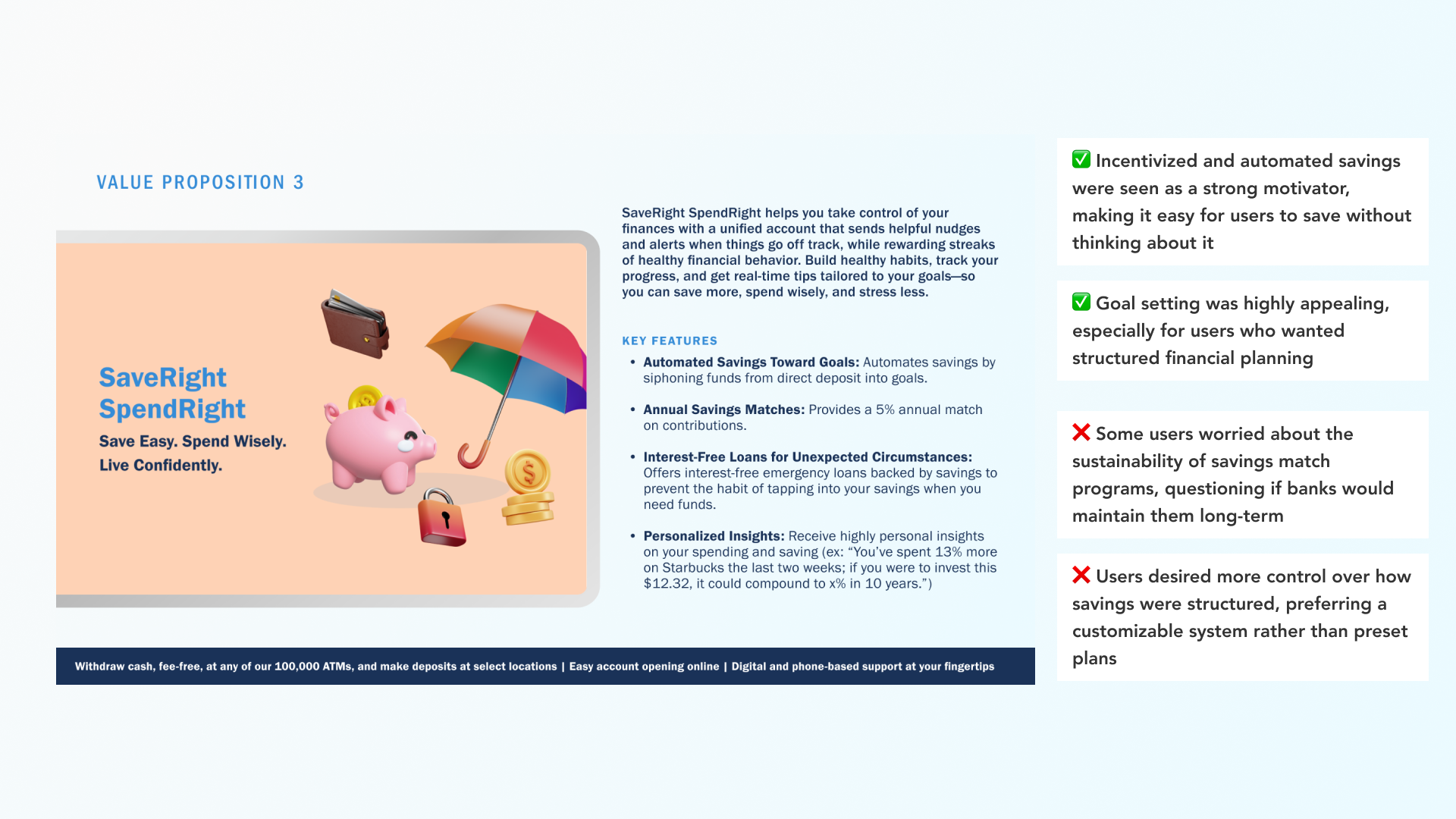
SaveRight SpendRight
Value Proposition 03 · SaveRight SpendRight
Save Easy. Spend Wisely. Live Confidently.
🔍 Problem

Members want to build healthy financial habits but lack a system that makes saving automatic, spending transparent, and progress visible, without requiring constant manual effort.

💡 Design Decision

SaveRight SpendRight auto-routes direct deposit into savings goals, offers a 5% annual match, provides interest-free emergency loans backed by savings, and delivers hyper-personalized spending insights, e.g. "You've spent 13% more on Starbucks this month; investing that $12 could compound to X."

📊 User Testing

Automated savings and goal-setting were the strongest motivators. Users were skeptical of long-term savings match sustainability, and wanted more control over how savings rules were structured.

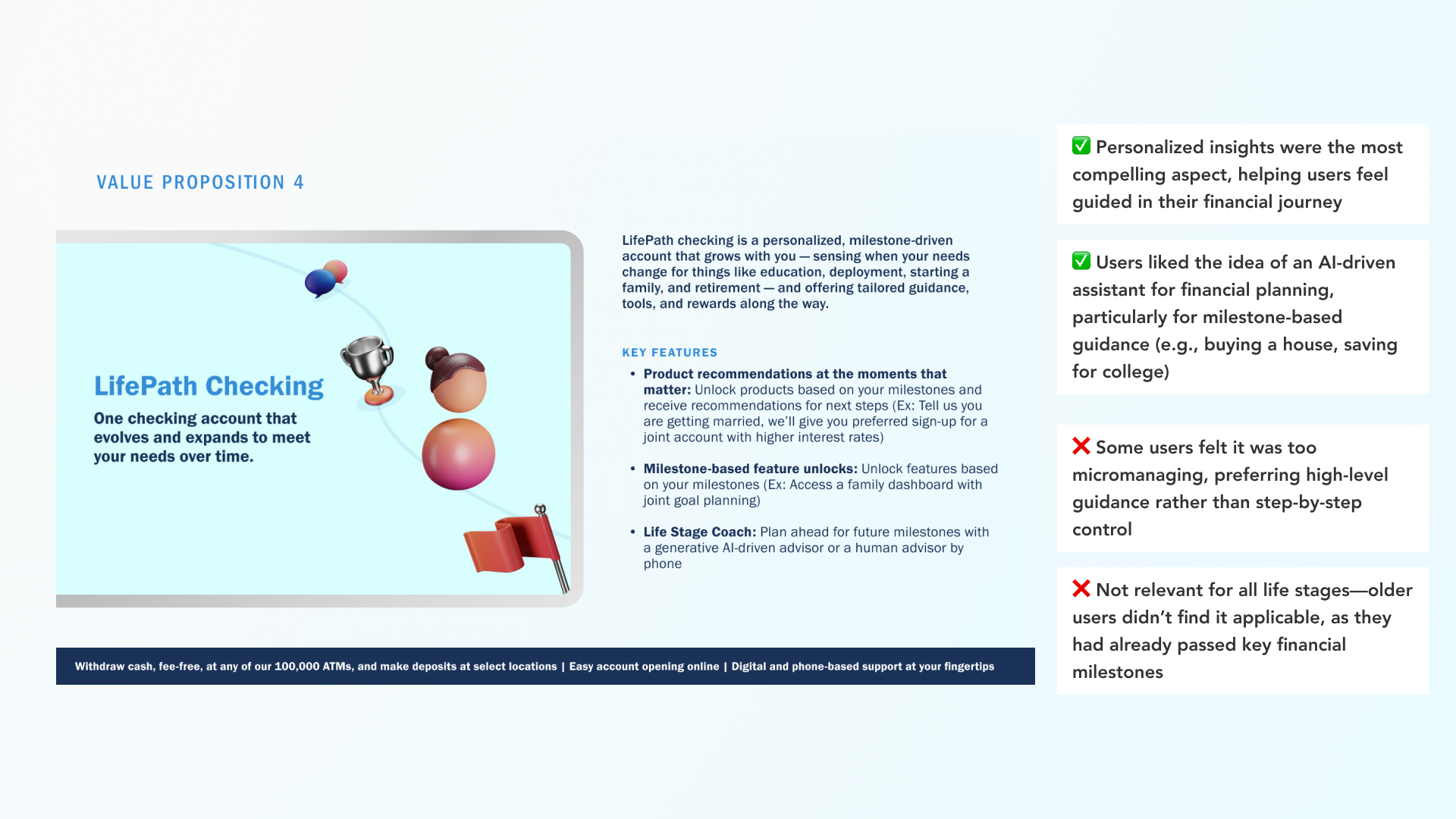
LifePath Checking
Value Proposition 04 · LifePath Checking
One account that evolves as your life does.
🔍 Problem

Members' financial needs shift dramatically across service, transition, and civilian life, but their bank account never adapts; there's no proactive system that senses milestones and responds with the right products and guidance.

💡 Design Decision

LifePath senses life milestones (marriage, deployment, retirement) and unlocks tailored products, features, and cross-sell recommendations in response. A generative AI life-stage coach offers forward-looking financial planning, with the option to speak to a human advisor.

📊 User Testing

Personalized milestone guidance was the most compelling aspect. Older users did not find it relevant, and some felt the level of automation was too prescriptive, preferring high-level direction over step-by-step control.

From User Insights to Strategic Direction

🤝
Stakeholder Alignment

Successfully aligned design, research, and business stakeholders around a shared future-state vision.

Concept Validation

Tested and refined 4 value propositions with real users, identifying the most desirable opportunities before investment.

🚀
Foundation for Future Investment

Insights and validated concepts informed the next phase of checking account strategy and business case development.